Northern Institute
Sensing an Inland Wetland: Glitches, Patches and Mosaics
| Presenter | Professor Mitchell Whitelaw | |
|---|---|---|
| Date/Time |
to
|
|
| Contact person |
Northern Institute
|
|
| Location |
Room 7.21/7.22, Level 7 CDU Danala Education and Community Precinct, 54 Cavenaugh Street, Darwin. |
|
| Open to | Public | |
About the seminar
This talk reports on research investigating multimodal sensing for wetland environments, in collaboration with the Commonwealth Environmental Water Office Flow-MER program. Audio recorders, time-lapse and motion-triggered cameras gathered data over a four month period at a wetland in the western reaches of the Murrumbidgee river. The resulting website, Mosaic: Life on the Western Lakes, experiments with approaches to structuring, presenting and narrating this data.
Distributed sensing is increasingly used to measure and manage living places, and in a range of other social and cultural practices. Critiques from the social sciences frame this sensing as panoptic biosurveillance, or a continuous, extensive field of capture. In practice, as this work shows, sensing is place-based, patchy and discontinuous, rife with glitches and contingencies. Data gathering practices sensors, classifiers, protocols and their design and deployment create bounded, selective views of an ecological complex. These views in turn shape ontological categories and hierarchies of value and attention. Combining approaches from the environmental humanities, STS and design, this work asks how we might see, or see around, the edges of such digital patches. How might such fragments be reassembled, and how might such mosaics entangle us with the extensive and troubled relations of living places like this?
About the presenter

Mitchell Whitelaw is an academic, writer and maker with interests in digital design and culture, data practices and digital collections. His scholarship is practice-based and collaborative; he has developed public digital projects with partners including the Atlas of Living Australia, the State Library of NSW, the Commonwealth Environmental Water Office and the National Gallery of Australia. His current research investigates environmental and biodiversity data, and digital design for a more-than-human world. Mitchell is Professor of Design in the School of Art and Design at the Australian National University.
Register for the event
In-person: RSVP here
Please RSVP here to attend in person—limited seating.
Online registration: Register here
Once you register, you will receive an individual link from Microsoft Teams
Getting there
Please be aware that the Danala underground car park will be closed from Monday 31 August to Friday 25 September as construction takes place. Visit this website to see options for parking around the Darwin City area.
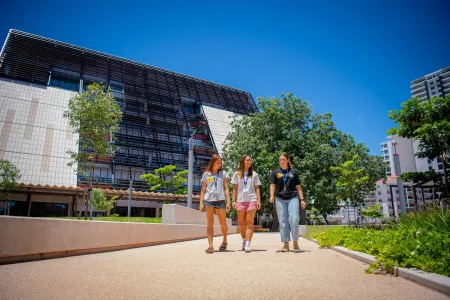
Room 7.21/7.22, Level 7,
CDU Danala Education and Community Precinct,
54 Cavenaugh Street,
Darwin.
Related Events

Clean Energy, New Waste: Exploring a Just and Circular Transition
Read more about Clean Energy, New Waste: Exploring a Just and Circular TransitionJoin us for a special Social Sciences Week webinar exploring the hidden waste challenges of the clean energy transition, and discover how social science, equity, and circular economy thinking can help create a truly sustainable future.

Mangroves and the rising tide
Madeline will discuss how long-term monitoring of mangrove surface elevation provides critical insight into the long-term persistence of mangroves and the ecosystem services they provide under rising sea levels.
Read more about Mangroves and the rising tide
Australia’s ecosystems at scale: TERN data, collections and drone observations
Dr Donna Lewis will showcase the Terrestrial Ecosystem Research Network's (TERN) program capabilities, with a focus on the Ecosystem Surveillance program — including long-term monitoring data, biological collections and environmental samples, and drone-based observations.
Read more about Australia’s ecosystems at scale: TERN data, collections and drone observations


