News article
Science judges place CDU ecologist in top tier
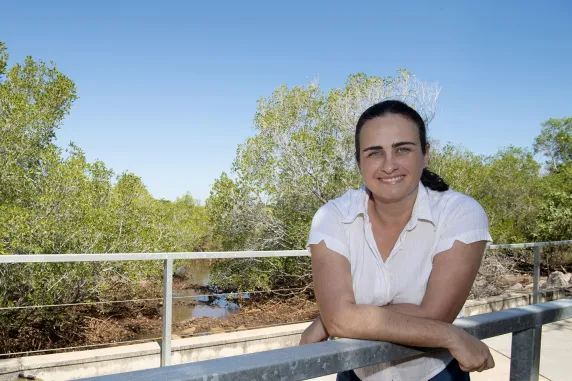
Charles Darwin University ecologist Dr Carla Eisemberg has been recognised for research excellence by judges searching for Australia’s nominee for the internationally prestigious APEC ASPIRE Prize.
Dr Eisemberg was shortlisted among three top-ranked Australians in a competition run by the Australian Government and the Australian Academy of Science, an honour that carries a $2000 prize.
It is understood that Dr Eisemberg is the first Territorian finalist in the six years that the Australian Academy of Science has overseen the ASPIRE Prize (APEC Science Prize for Innovation, Research and Education).
The winner was marine conservationist Dr Amelia Wenger and the other finalist Dr Jeremy Simmonds, both of Queensland.
Dr Eisemberg, who is regarded as a “tropical waters turtle expert”, said it was an honour to have been selected as a finalist and have her research acknowledged.
“I’d like to congratulate my fellow finalists and especially Dr Wenger, the Australian nominee for the APEC Prize,” Dr Eisemberg said.
The CDU Science Outreach Manager’s research has shown the importance of wild meat as a source of micronutrients to remote communities.
A major discovery during this project was the finding that turtle meat has a high concentration of iron.
“These results may be used in future health programs addressing anaemia or may serve as an inspiration for Indigenous enterprises, such as turtle farming,” Dr Eisemberg said.
The Darwin-based researcher is also the International Union for Conservation of Nature red list (threatened species) coordinator for the Tortoise and Freshwater Turtle Specialist Group.
In 2018 she coordinated a red listing workshop in Singapore where specialists assessed the status of 90 species of tortoises and freshwater turtles.
Related Articles

AI models show promising results in ICU mortality predictions
Predicting mortality risk in intensive care unit patients is a crucial part of medical treatment, and recent research has found Artificial Intelligence could help clinicians make more efficient and accurate decisions.
Read more about AI models show promising results in ICU mortality predictions
How ants are cashing in on the fight against money laundering
An AI model inspired by ants, bees, and birds could be the key to cracking down on blockchain-based money laundering, new research led by Charles Darwin University (CDU) has found.
Read more about How ants are cashing in on the fight against money laundering
‘Ecological engineers’ an existential threat to wildlife of iconic wetland
A study examining how feral water buffalo interact with landscapes has uncovered how the pest is having disastrous impacts on northern long-necked turtles in the Top End’s tropical wetlands.
Read more about ‘Ecological engineers’ an existential threat to wildlife of iconic wetland


