News
Researcher uses 3D modelling to measure biomass of trees for carbon monitoring
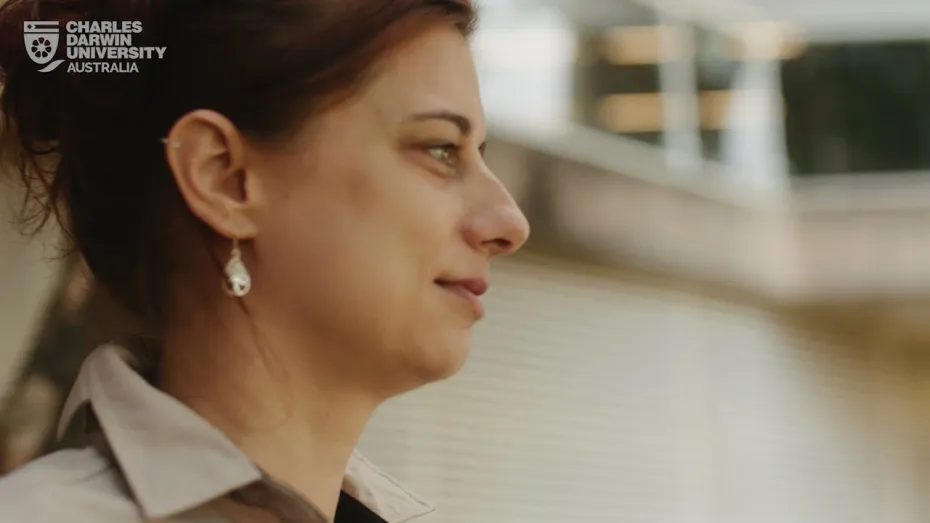
Researcher and PhD student Linda Luck is providing valuable data for carbon monitoring through a scanning technology that generates digital 3D models of trees.
Ms Luck, from the Research Institute for the Environment and Livelihoods (RIEL) at Charles Darwin University (CDU), is investigating how the biomass of savanna trees varies in time and space.
The scanner uses laser beams to produce precise 3D modelling used to calculate the biomass of trees, which can be useful for carbon accounting applications such as prescribed burning to capture and store carbon dioxide or to better understand the global carbon cycle.
“The technology I use is called terrestrial LiDAR, which stands for laser scanning and ranging. It’s essentially using a laser beam to measure the distance to the nearest object, but it does so millions of times for each scan,” Ms Luck said.
“The 3D models give a very detailed look so we can get a better idea of the structure of individual trees. If you’ve never seen the data, you can picture it like a 3D computer game with very detailed renderings – only these ones are based on real trees.”
Ms Luck is originally from Germany and came to study a Bachelor of Environmental Science at CDU in 2013.
Her PhD topic is in investigating the above-ground woody biomass of trees in the Northern Australian savannas.
“My research has already highlighted just how variable tree structure is due to damage from termites, storms and fire.”
“No tree looks the same, that’s why traditional methods struggle. Laser scanning of woody vegetation is an incredibly powerful tool, but it’s still in its developmental phase. I am finding ways to make data processing and analysis more streamlined,” she said.
“Currently, I am investigating how we can use LiDAR to better quantify the above-ground biomass in our trees and monitor change over time.”
Ms Luck has an innate curiosity and passion for trees, so it comes naturally that she chooses to study trees to better understand how they interact with their environment in the Northern Territory.
“Trees are just beautiful. I hope that this technology can be used a lot more in the future,” she said.
According to Ms Luck, the scanning device can be used broadly in many industries.
“It’s used in industries like horticulture, archaeology, architecture and mining. It is used to determine the dimensions of objects. From that, I can calculate the volume and based on the density of the wood the biomass and the carbon content.”
“This technology has a lot of potential. Knowing the challenge that the Northern Territory faces in quantifying the amount of carbon in the environment, it can really make a change,” Ms Luck said.
CDU Research Week is running from 14 - 23 August and a series of research projects by CDU scholars will be featured to highlight the University’s research efforts and achievements.
Charles Darwin University is actively seeking Higher Degree by Research students to take part in research projects like this. Scholarships are available. Learn more here.
Related Articles

AI models show promising results in ICU mortality predictions
Predicting mortality risk in intensive care unit patients is a crucial part of medical treatment, and recent research has found Artificial Intelligence could help clinicians make more efficient and accurate decisions.
Read more about AI models show promising results in ICU mortality predictions
Urgent action needed as Gulf dugong numbers decline, Traditional Owners and researchers warn
Results from the 2025 Gulf of Carpentaria dugong aerial survey have revealed a sharp decline in numbers compared with the last survey conducted in 2007, sparking a call from Traditional Owners for urgent action.
Read more about Urgent action needed as Gulf dugong numbers decline, Traditional Owners and researchers warn
CDU Centre for Better Health Futures featured in building awards
The Charles Darwin University (CDU) Centre for Better Health Futures received four awards at the 2026 Master Builders NT Excellence in Building and Construction Awards.
Read more about CDU Centre for Better Health Futures featured in building awards


