News Article
NT farmers share sustainability knowledge in India
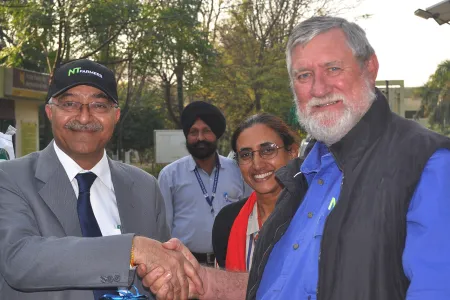
Northern Territory agriculturalists have begun a sustainable farming knowledge exchange with their Indian counterparts.
A $66,000 Department of Foreign Affairs and Trade grant (funded through Australia-India Council) has helped deliver the first stage in a Charles Darwin University-led sustainable farming knowledge exchange between NT agriculturalists and farmers in the Punjab.
In December 2019 Research Institute for the Environment and Livelihoods Research Fellow Dr Kamaljit Sangha led a group of eight NT farmers on a tour of the sub-continent’s Punjab agricultural region, which also included a workshop at one of the region’s higher education institutes.
Dr Sangha said the 10-day research trip was an “eye-opener” with regard to a wide range of sustainable organic practices developed by the region’s “zero-input” farmers.
“The zero-input farming techniques in the Punjab region grew out of a mounting dissatisfaction among a relatively small group of farmers after the 1960s Green Revolution, which has led to widespread mechanised agriculture for the last few decades to meet India’s food demand for wheat and rice,” Dr Sangha said.
“The ‘Green Revolution’ has created a huge ecological backlash giving rise to organic farms that grow up to 10 different crops and more, which rely solely on organic fertilisers and pesticides.”
Dr Sangha said the collaboration between the Punjab Agricultural University and the region’s sustainable farmers had led not only to growth in development of sustainable farming methods, but also to the creation purpose-built capital equipment – designed and built by the university’s engineering department.
Exchange group delegate and NT Farmers Association member Greg Owens said the NT farmers were impressed by the Punjabi farmers’ organic farming practices that increased soil organic matter and improved water use efficiency – achieved with sustainable techniques such as understorey planting, row cropping and recycling cattle waste through custom-made digesters (which is then added to irrigation water).
“The Charles Darwin University / NT Farmers sustainable farming study tour and knowledge exchange of the Punjab region in India was a fascinating and informative experience,” Mr Owens said.
Dr Sangha said planning was under way to host a reciprocal delegation of farmers from the Punjab in May or June this year – an exchange that would include a sustainable farming conference on CDU’s Casuarina campus.
Related Articles

AI models show promising results in ICU mortality predictions
Predicting mortality risk in intensive care unit patients is a crucial part of medical treatment, and recent research has found Artificial Intelligence could help clinicians make more efficient and accurate decisions.
Read more about AI models show promising results in ICU mortality predictions
Urgent action needed as Gulf dugong numbers decline, Traditional Owners and researchers warn
Results from the 2025 Gulf of Carpentaria dugong aerial survey have revealed a sharp decline in numbers compared with the last survey conducted in 2007, sparking a call from Traditional Owners for urgent action.
Read more about Urgent action needed as Gulf dugong numbers decline, Traditional Owners and researchers warn
CDU Centre for Better Health Futures featured in building awards
The Charles Darwin University (CDU) Centre for Better Health Futures received four awards at the 2026 Master Builders NT Excellence in Building and Construction Awards.
Read more about CDU Centre for Better Health Futures featured in building awards


