Moo-ving the boundaries: New research evaluates virtual fences for use on NT cattle stations
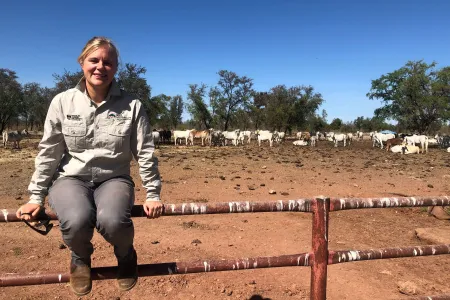
Cattle producers in Northern Australia face unique challenges when adapting tools like virtual fences on their properties, but new research from Charles Darwin University (CDU) is set to break down the barriers to this technology.
Virtual fences remotely map and control livestock such as cows by fitting the animal with a GPS collar that delivers audio cues and electric pulses to the animal if they approach a pre-set boundary.
CDU Associate Professor Beth Penrose said the technology would be invaluable to northern beef producers who oversee millions of hectares of land in environments prone to fire and flooding.
Associate Professor Penrose said virtual fences wouldn’t just boost farmers’ productivity but would also benefit the environment.
“One of the main types of landscape that we want to protect is riparian areas – areas around water,” she said.
“The watercourses often flood during the wet season and then recede, so if you wanted to fence the watercourse with a normal fence, this would wash away and you would need to replace it, which takes a lot of time and money.
“Permanently fencing off watercourses could make the riparian areas fire corridors, whereas virtual fencing allows native herbivores such as kangaroos to keep eating the vegetation to keep the fuel load low.”
Virtual fences are heavily relied upon in southern states, where calves are separated from cows earlier, but northern beef producers typically operate using cow-calf systems, keeping the pair together much longer.
CDU Professor Sunil Kadri said the collars used in virtual fence technology were not considered suitable for calves, which poses a unique challenge for Territory farmers.
“We don’t know whether the calves will respect the virtual fence, whether mothers will ignore the fence if their calves are on the other side of it, and what the implications of this are for welfare and behaviour,” Professor Kadri said.
"It is important we develop an understanding of the implications of using virtual fences in northern rangelands, for the behaviour and welfare of calves and cows, as well the potential for using the technology across a number of applications within this environment.”
This research is being funded and supervised in partnership with the CSIRO and Gallagher Animal Management through the CSIRO Industry PhD scheme.
Related Articles

AI models show promising results in ICU mortality predictions
Predicting mortality risk in intensive care unit patients is a crucial part of medical treatment, and recent research has found Artificial Intelligence could help clinicians make more efficient and accurate decisions.
Read more about AI models show promising results in ICU mortality predictions
How ants are cashing in on the fight against money laundering
An AI model inspired by ants, bees, and birds could be the key to cracking down on blockchain-based money laundering, new research led by Charles Darwin University (CDU) has found.
Read more about How ants are cashing in on the fight against money laundering
‘Ecological engineers’ an existential threat to wildlife of iconic wetland
A study examining how feral water buffalo interact with landscapes has uncovered how the pest is having disastrous impacts on northern long-necked turtles in the Top End’s tropical wetlands.
Read more about ‘Ecological engineers’ an existential threat to wildlife of iconic wetland


