News
Capturing Nature reveals Australia’s earliest scientific photography
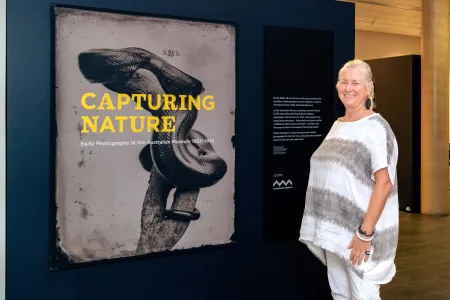
Australia’s earliest scientific photographs on display at CDU Art Gallery reveal the scientific discoveries of Australian Museum scientists between the 1850s-90s.
A new exhibit, ‘Capturing nature: early photography at the Australian Museum 1857 –1893’ opens on November 16 and features 67 large format photographic prints drawn from the Australian Museum’s extensive archival collection of glass plate negatives.
These prints tell the story of the advent of photography in the young colony, less than 10 years after the birth of photography in Europe.
The subjects depicted vary from a large sunfish, the flipper of a sperm whale, to a gorilla, and the fragile bones of a flamingo.
Most of the specimens photographed at the museum are by taxidermist, Henry Barnes and his son, Henry Barnes Jnr with the help of the Australian Museum’s pioneering Curator Gerard Krefft.
CDU Art Gallery Curator, Dr Joanna Barrkman, said visitors to the exhibition can view the 67 rich, prints together with a video that explains the glass plate photography technique.
“Collectively, these works highlight the legacy of this photographic medium, demonstrating the importance of glass plate photography as a viable and popular art, as well as a recorder of history and science,” Dr Barrkman said.
“The images range from the initial tentative experiments in the 1850s to the time when photography was becoming an indispensable part of museum practice in the early 1890s.”
Australian Museum Director and CEO Kim McKay AO said some of the earliest adopters of photography were scientists who were quick to see its potential for capturing the process of discovery and describing new species.
“In the Victorian era, museums were the public face of science. At the Australian Museum, the arrival of curator and scientist Gerard Krefft in 1864 marked a fortuitous coming together of skills, experience and technology,” Ms McKay said.
“The images by Gerard Krefft, and his taxidermist, Henry Barnes, not only produced records for the Museum, but also helped them share the Museum's work around the world. Their early images showcase the creativity, innovation and experimentation that were, and remain, part of the Australian Museum's DNA.”
Beautiful, haunting and sometimes strange, Capturing Nature is not only a unique record of early Australian science but also brings to life the story of one of humankind’s greatest inventions.
Capturing Nature will be exhibited at CDU Art Gallery from November 17 until April 1, 2023 and will be opened by Dr Kirsten Abbott, Head of Science, Museum and Art Gallery of the Northern Territory on November 16 at 6pm.
Related Articles

AI models show promising results in ICU mortality predictions
Predicting mortality risk in intensive care unit patients is a crucial part of medical treatment, and recent research has found Artificial Intelligence could help clinicians make more efficient and accurate decisions.
Read more about AI models show promising results in ICU mortality predictions
Urgent action needed as Gulf dugong numbers decline, Traditional Owners and researchers warn
Results from the 2025 Gulf of Carpentaria dugong aerial survey have revealed a sharp decline in numbers compared with the last survey conducted in 2007, sparking a call from Traditional Owners for urgent action.
Read more about Urgent action needed as Gulf dugong numbers decline, Traditional Owners and researchers warn
CDU Centre for Better Health Futures featured in building awards
The Charles Darwin University (CDU) Centre for Better Health Futures received four awards at the 2026 Master Builders NT Excellence in Building and Construction Awards.
Read more about CDU Centre for Better Health Futures featured in building awards


